The 19th century arrival of the meat grinder was a seminal event in Turkish food history. Minced meat was cheaper than regular cuts and quickly became popular among the general public and the Ottoman palace kitchen alike. The popularity of meatballs skyrocketed, and a number of new versions first saw light of day at this time.
One of them had a strange name. Ladies’ thighs.
Kadınbudu köfte is possibly the most unique meatball dish of Turkish cuisine (and there are a lot of versions to choose from). Its name is said to come from being shaped like voluptuous ladies’ thighs. The dish was the favourite of many a sultan, so perhaps the harem played a role here, too. Something tells me it probably wouldn’t have gotten this name were it invented today, though. #metoo
The uniqueness of kadınbudu köfte doesn’t just come from its name, though.
A unique method for making meatballs
There are no eggs or breadcrumbs in kadınbudu köfte, but cooked rice. This makes the meatballs more crumbly, but also juicier. They’re therefore an excellent choice when you’ve got leftover rice.
Unusually, half of the meat is fried with onions before being shaped into meatballs with the remaining (raw) meat. Finally, they’re covered in flour and egg before frying, giving them a battered appearance quite unlike other forms of meatballs, where the browning of the meat is an important part of their flavour profile. Here, that’s taken care of by pre-frying half of the meat.
It may sound a little odd, but it really works!

Unusually, these steps make these meatballs delectable not just warm, but also at room temperature. They’re therefore great if you’re making ahead or feeding a crowd. Personally, though, I like them with mashed potato and a nice salad, for dinner.
Serving suggestion
I like having kadınbudu köfte for dinner with mashed potato and a salad. Potato chips, fresh bread or a chunky salad also work really well alongside. Given there’s rice in the meatballs, I find rice or bulgur works less well alongside.
Since they’re delicious at room temperature, they’re an excellent choice for picnics or hikes.
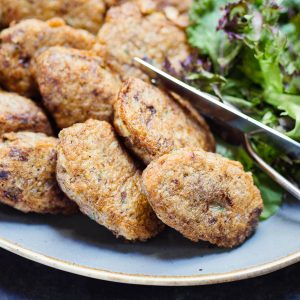
Kadınbudu köfte
Ingredients
- 40 g rice (short or medium grain), or 120 g/½ cup cooked rice
- water, to boil the rice
- 2 Tbsp olive oil, I use a mild extra virgin
- 1 medium onion, finely chopped
- 400 g minced lamb, or beef or a mixture
- 1 tsp ground cumin
- 15 g flat-leaf parsley (Italian parsley), finely chopped
- 1 egg yolk
- ½ tsp salt
- ¼ tsp black pepper, I use freshly ground
To fry
- 2 eggs, minus the egg yolk used to make the köfte
- 4–5 Tbsp plain flour (all-purpose)
- 4–5 Tbsp olive oil
How I make it
- In a small pot, bring plenty of water to boil. Salt as if it were a soup, then add rice and leave to simmer until the rice is tender, 10–12 minutes. Drain.
- Meanwhile, heat a large, thick bottomed frying pan over medium heat. Fry the onion in the olive oil for 2–3 minutes, stirring regularly, then add half (200 g/7 oz) of the minced meat and about half of the salt. Fry until the liquids have evaporated and the mixture is nice and golden, 8–10 minutes. Add cumin, give it a stir and then take off the heat. Add the rice and mix again. Leave to cool completely.
- Crack the eggs into a wide, shallow bowl. Don’t whisk them yet – one of the egg yolks will go into the köfte mixture. On a separate plate or wide, shallow bowl, add the flour.
- Mix the fried, now cooled, meat mixture with the remaining raw meat (200 g/7 oz), one of the egg yolks, the flat-leaf parsley and the remaining salt and pepper. Once homogenous, cover and transfer to the fridge to cool completely. If you're short on time, you can skip the refrigeration, but it makes it a lot easier to shape the köftes as well as allows the flavours to mingle and settle.
- Heat a large thick bottomed frying pan over medium heat (I use the same one as earlier). Add plenty of olive oil, making sure to cover the frying pan well.
- Shape the meat mixture into 10–12 equally sized meatballs in the shape of ladies’ thighs (or another shape you prefer).
- Coat the köftes well with flour, then shake off the excess. Dip them in the egg mixture until well coated, then transfer immediately to the hot frying pan. Fry until golden and cooked through, about 3–4 minutes per side, depending on how you shaped your köftes. Drain on kitchen paper. You’ll probably have to do this in two or more batches.
- Serve the meatballs hot, warm or at room temperature.