Recipe
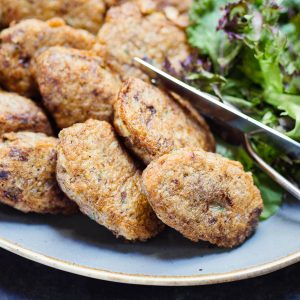
Kadınbudu köfte
Unique Turkish meatballs with an even more unique name: "Ladies' thighs".
Yield: servings
Email
Print
Pin
Ingredients
- 40 g rice (short or medium grain), or 120 g/½ cup cooked rice
- water, to boil the rice
- 2 Tbsp olive oil, I use a mild extra virgin
- 1 medium onion, finely chopped
- 400 g minced lamb, or beef or a mixture
- 1 tsp ground cumin
- 15 g flat-leaf parsley (Italian parsley), finely chopped
- 1 egg yolk
- ½ tsp salt
- ¼ tsp black pepper, I use freshly ground
To fry
- 2 eggs, minus the egg yolk used to make the köfte
- 4–5 Tbsp plain flour (all-purpose)
- 4–5 Tbsp olive oil
How I make it
- In a small pot, bring plenty of water to boil. Salt as if it were a soup, then add rice and leave to simmer until the rice is tender, 10–12 minutes. Drain.
- Meanwhile, heat a large, thick bottomed frying pan over medium heat. Fry the onion in the olive oil for 2–3 minutes, stirring regularly, then add half (200 g/7 oz) of the minced meat and about half of the salt. Fry until the liquids have evaporated and the mixture is nice and golden, 8–10 minutes. Add cumin, give it a stir and then take off the heat. Add the rice and mix again. Leave to cool completely.
- Crack the eggs into a wide, shallow bowl. Don't whisk them yet – one of the egg yolks will go into the köfte mixture. On a separate plate or wide, shallow bowl, add the flour.
- Mix the fried, now cooled, meat mixture with the remaining raw meat (200 g/7 oz), one of the egg yolks, the flat-leaf parsley and the remaining salt and pepper. Once homogenous, cover and transfer to the fridge to cool completely. If you're short on time, you can skip the refrigeration, but it makes it a lot easier to shape the köftes as well as allows the flavours to mingle and settle.
- Heat a large thick bottomed frying pan over medium heat (I use the same one as earlier). Add plenty of olive oil, making sure to cover the frying pan well.
- Shape the meat mixture into 10–12 equally sized meatballs in the shape of ladies' thighs (or another shape you prefer).
- Coat the köftes well with flour, then shake off the excess. Dip them in the egg mixture until well coated, then transfer immediately to the hot frying pan. Fry until golden and cooked through, about 3–4 minutes per side, depending on how you shaped your köftes. Drain on kitchen paper. You'll probably have to do this in two or more batches.
- Serve the meatballs hot, warm or at room temperature.
Notes
The Ottomans used lamb for these meatballs, but today most people use beef. I prefer the Ottoman way, but feel free to do as you please.
Feel free to make the meatballs in a shape and size that you prefer. Mine aren’t entirely authentic. I prefer them slightly smaller and flatter than what is traditional. This makes them easier to fry evenly. Traditional shapes are a little larger and thicker. If using a different shape, you’ll need to adjust the cooking time accordingly. If they’re a lot thicker than mine, you may also need to lower the heat a bit to avoid burning.