


Turks love a biscuit. The options at a Turkish patisserie can be overwhelming, whether you’re looking for something sweet or something savoury.
The savoury biscuits are my favourites. Perfect little bites to go along with a generous cup of black tea.
Unfortunately, many patisseries turn to margarine and other lower quality substitutes. I was therefore delighted to find out they’re quite easy to make at home as well. I tried a few versions, and this is the one that gave me the texture and flavour I was looking for.

What is kandil simidi?
This recipe is for what Turks refer to as kandil simidi. Kandil simidi is a savoury, crumbly biscuit (cookie) shaped as a circle. It may be plain or have seeds added.
Some may take note of the name, which implies it’s a variant of simit. The similarity is mostly to do with the sesame crusting and circular shape.
As is usual with traditional foods, different versions abound. You can also make it plain, or with nigella seeds.
There are also different ways of making the dough. In my mind, the key is to get a crumbly texture and a rich flavour that goes well with black tea.
I’ve tried a few recipes, and this is how I find they turn out the best—perfect texture and delicious flavour.
The ingredients
You may notice a slightly unusual ingredient in mahleb. This is the powdered kernels of a specific species of cherries.
Mahleb is commonly used in baked goods across the Middle East, where it adds depth of flavour with flavours reminiscent of bitter almonds—without becoming too dominant. The spice has made its way into Turkish cuisine through the country’s Eastern parts, where it’s much more widely used than in the Western regions. You’ll find it used in many Turkish and Middle Eastern bakes—another example is poğaça.
If you can’t get hold of mahleb, just omit it. You’ll still get a delicious biscuit. I recommend getting hold of it if you can, though.
Please use ghee or butter as your fat when making this recipe. Many Turkish patisseries substitute margarine, very much to the detriment of the end result. In fact, this is the main reason I prefer making it at home.
Yoghurt and vinegar is my favoured combination to achieve the crumbly texture these biscuits should have.
The egg wash has a little grape molasses mixed in. Known as pekmez in Turkish, this gives a delicious sweet touch to the crust. It’s the same ingredient that gives the simit crust its unique flavour.
For the topping, the egg wash is mandatory, but the seeds are optional. I like using nigella seeds on half and sesame seeds on the other half. This is what I’ve suggested in the recipe as well, but you can choose just one of them, or omit them altogether.
The method
Since the dough uses baking powder rather than yeast, this is a very simple dough to make. Don’t knead it, the ingredients only need to come together to form a homogenous dough.
I usually weigh each piece of dough to ensure equal size. This is best not only visually, but ensures even cooking.

The sesame seeds need to be toasted until golden before use. This gives them a deeper flavour that is more suitable for the biscuit than the raw, white sesame seeds. As with regular simit, the oven cooking time isn’t sufficient to toast them during baking, so they need to be toasted before you add them to your biscuits.
Be generous with the sesame seeds. Like regular simit, you usually dip the biscuit in them until you cannot fit a single sesame seed more before placing on the tray for baking.
Nigella seeds are quite punchy, so a pinch is enough for each biscuit. You don’t need to do anything to them before adding them to the biscuits.
Serving suggestions and storage
These Turkish biscuits are best enjoyed as a midday snack, alongside a freshly brewed cup of black tea (or other tea of your choice).
Once baked, they keep well for a few of days if kept in a sealed jar at room temperature. They’ll soon lose their crunchiness and start getting a stale flavour, though, so don’t keep them lying around for too long.
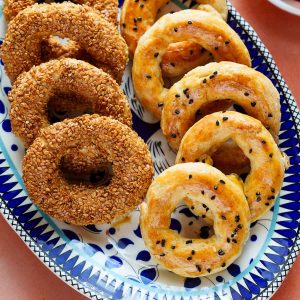
Turkish savoury tea biscuits (Kandil simidi)
Ingredients
- 240 g plain flour (all-purpose)
- 1 tsp mahlab, (optional)
- 1½ tsp baking powder
- ¾ tsp fine sea salt
- 145 g clarified butter (ghee), or butter, melted
- 70 g Greek yoghurt, room temperature
- 12 g apple cider vinegar
Egg washes
- 1 egg, separated into white and yolk
- 2 tsp grape molasses (üzüm pekmezi), or date molasses (dibs/silan)
- 1 tsp water
Topping
- 60 g sesame seeds, toasted until golden
- 2–3 tsp nigella seeds, optional
How I make it
- Preheat the oven to
 180 °C. Line two baking trays with parchment paper.
- Whisk the egg white with grape syrup. In a second bowl, whisk the egg yolk with 1 tsp water. Place the toasted sesame seeds in a third bowl or plate (see notes below for toasting).
- In a large bowl, combine the flour, mahleb, baking powder and salt. Stir in the melted ghee or butter, yoghurt and vinegar. Mix until it comes together into a soft dough, but don't knead it any further than that.
- Divide the dough into 20 pieces of about 25 g (⅞ oz)each. Roll each piece into a 20 cm (8 in) sausage. Join the ends to form a ring.
- Place 10 rings on one of the prepared trays. Brush them half with the egg yolk wash, then sprinkle with nigella seeds.
- Dip the remaining 10 rings into the egg-white mixture, then coat thoroughly with sesame seeds. Place on the second prepared tray.
- Bake on the middle shelf until golden brown, 18–20 minutes. Allow to cool completely before serving.


