A beloved staple of many Cypriot homes, elioti is a wonderfully more-ish olive cake.
What is elioti?
The ingredients and methods vary from family to family, but the core is the same: A savoury bread with olives, halloumi and herbs.
Most versions are made as you would cake, but savoury, with eggs and baking powder to leaven.

In my research, however, I was intrigued by Selin Kiazim’s family recipe in her book Oklava (though Kiazim herself grew up in London, her family is from Northern Cyprus). This one has more in common with focaccia.
I later came across recipes similar to Kiazim’s with a different name. Yet more evidence of the dish’s importance in the local culture! Many of the most popular dishes in this part of the world have multiple names, depending on region, family and slight variations in the preparation.
How I make my elioti
Having tested both of the methods above, I hands down prefer the bread dough version. It’s moister and tastier than its cake like equivalent.
I therefore make my elioti in the style of a no-knead bread (no need for a mixer!). I use, however, a lot more yeast than what’s typical for no-knead breads.
As a result, this bread comes together with minimal effort. It takes just a couple of hours from start to finish, and for the vast majority of time, you don’t even need to watch it.
This makes elioti a great bread to make if it’s too late to start a dough the night before.
A few notes on the ingredients
Olive oil
As ever, I recommend using a good quality extra virgin olive oil. Not just for flavour, but also for texture.
Poor quality oil can make the bread greasy rather than delicate and moist. I use a mild extra virgin olive oil.
I like to use plenty of oil on the baking parchment. Not because the paper needs it, but because it adds a ton of flavour to the edges and bottom of the bread. Don’t skip this part!
Halloumi
Halloumi is a salty, firm Cypriot cheese that can be grilled or fried without melting. If you can find one of Cypriot or Greek origin, that would be ideal. If your package size differs slightly from mine, a little more or less is perfectly fine and won’t affect the result significantly.
Olives
It’s worth getting good quality black olives for this bread. I always buy them whole, stone in and not stored in brine, then pit them myself. I find these have superior flavour to the already pitted and brined versions.
Some use more olives than I do in their bread, but both my olive loving partner and I found this amount just right. Feel free to adapt to suit your own taste.
Mint
Dried mint is the final ingredient giving this bread its unique flavour.
I go light for a hint of herbiness, but feel free to add 2–3x the amount listed for a more strongly herbaceous bread (they do love their dried mint in Cyprus).

Serving suggestions
This bread is an excellent accompaniment to all kinds of Mediterranean-inspired salads and cured meats. It also pairs well with soups – and is delightful on its own alongside a cup of black tea.
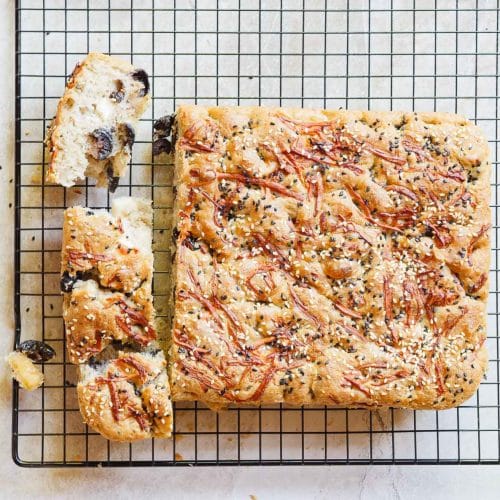
Cypriot olive halloumi bread
Ingredients
- 320 g water
- 6 g dried yeast
- 400 g plain flour (all-purpose), all-purpose
- 6 g salt
- 1 Tbsp dried mint
- 100 g extra virgin olive oil, (I use a mild one), plus extra for topping
- 250 g halloumi, of which 225 g/8 oz cut into 1 cm (⅓ in) cubes and 25 g/1 oz grated
- 120 g black olives, pitted (net weight 90–100 g / 3 ½ oz)
- 1 tsp sesame seeds
- 1 tsp nigella seeds
How I make it
- Mix the water, dried yeast and flour in a large bowl. It only needs to come together. Cover and leave to rest for 30 minutes.
- Line 1 baking tin measuring 26×20 cm (10×8 in) with baking parchment. Grease with olive oil.
- Add the salt, dried mint and olive oil to the dough. Incorporate by squeezing the dough between your fingers to combine everything thoroughly. Add the halloumi cubes (not the grated halloumi) and olives. Gently mix until well distributed. Pour the dough into the prepared baking tin.
- Cover the tin with plastic wrap or a moist towel. Leave to rise until doubled in size, 1–2 hours or more, depending on the temperature in your kitchen and the strength of your yeast.
- Meanwhile, preheat the oven to
 220 °C, top and bottom heat. If you have a baking stone, place it in the middle of the oven to heat through.
- When the dough is ready, drizzle 1–2 Tbsp extra virgin olive oil over the top. Oil your hands and press dimples partially into the dough as you would with focaccia. Top with the grated halloumi, sesame seeds and nigella seeds.
- Bake in the middle of the oven until the bread is golden and cooked through, 25–40 minutes.
- Cool the bread completely before slicing into pieces.